Choy Sum with Sweet Tau Kee

Vegetable July 12th, 2008
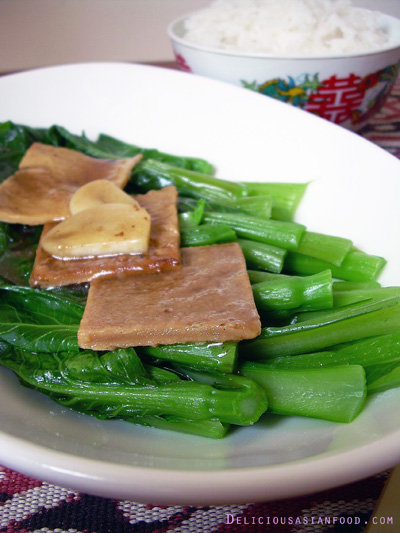
Choy Sum with Sweet Tau Kee

It was difficult for me to find the exact English equivalent for Sweet Tau Kee or Sweet Tou Kan, a type of soya product which is popular amongst vegetarians. Sweet Tau Kee comes in rectangular dried hard pieces and are brown in colour and you will need to soften them by pre-soaking in water for a few minutes prior to cooking. I have had experience where certain Sweet Tau Kee softens much faster than others depending on different manufacturers. After they have softened, you should cut them into smaller pieces as they measure approximately 15cm in length and 5 cm in width prior to cooking.

Sweet Tau Kee is not for everyone due to its unique taste, which can be bitter to some. Here, I have paired the Sweet Tau Kee with Choy Sum (菜心) or “Flowering Chinese Cabbage” so that there is a good balance between the subtle sweetness of the Tau Kee and the refreshing Choy Sum greens. This dish is quite easy to cook and with a little effort in presentation, you can dish out something which can rival what is being offered in the chinese restaurants. By the way, if you intend to serve this as a complete vegetarian dish, omit garlic from the ingredients.

This is my recipe for Choy Sum with Sweet Tau Kee Read the rest of this entry »

Pumpkin and Luncheon Meat Combo

Pork, Vegetable July 3rd, 2008

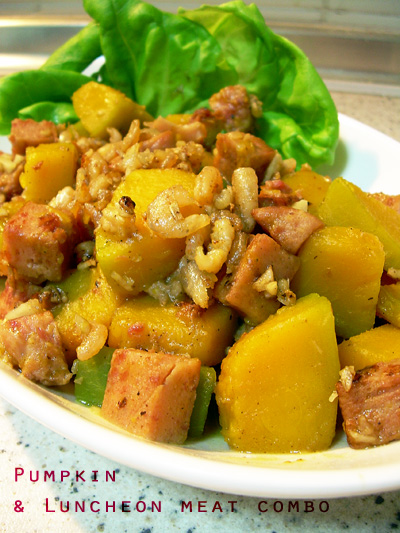
pumpkin luncheon meat

I had a small quarter of pumpkin the other day and we all know how sweet pumpkins are. But I was bored of stir-frying pumpkin with dried prawns and needed a change. After rummaging through my kitchen cabinet, I found a can of luncheon meat and I thought “why not?”. The sweetness from the pumpkin would complement the slightly saltish luncheon meat and that could be a good combo. So, what I did was to cut both ingredients into equal sized cubes and stir-fried them to make this pumpkin and luncheon meat combo. It turned out quite alright 😀

For this recipe, I cut the pumpkin and luncheon meat into cubes. You can cut them into slivers if you prefer it that way. Somehow, I could not resist the use of dried prawns to give it a slight seafood bite. If you are unable to get hold of dried prawns, I would recommend just omitting it altogether. Do take care with the seasoning as the taste depends on how sweet your pumpkin is and how salty your brand of luncheon meat is. So, use salt judiciously. Otherwise you will have to take extra helpings of steamed white rice and a double dose of water to flush them out 😛

This is my recipe for Pumpkin and Luncheon Meat Combo Read the rest of this entry »

Bak Chang Recipe

Chinese June 16th, 2008

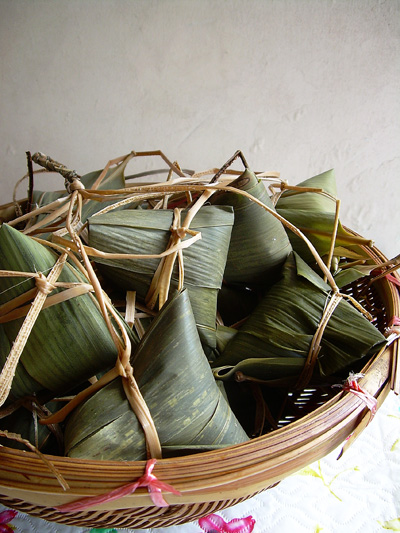
bak chang

We’ve finally reached the third installment in the Bak Chang series and today, I will feature our family Bak Chang recipe. Now, this recipe is definitely not for beginners as a considerable amount of skill and estimation on ingredients are required. You see, with home-cooked food, we don’t measure ingredients using measuring spoons or cups. Rather, it’s a lot to do with estimation or what the locals call “agak-agak” (“estimate”). So, this recipe is a guide for you so that you roughly know what ingredients go into the Bak Chang and how is is prepared and cooked.

This Bak Chang recipe is quite close to the Nyonya Bak Chang especially in the taste department. It is probably world’s apart from Cantonese Bak Chang which tends to be a bit on the saltish side and contains bigger chunks of ingredients. Those who are fond of eating saltish Bak Changs might find this not suited to their palate because our Bak Chang recipe is sweet and saltish with a slight emphasis on the former. Nevertheless, for those who are craving for a slightly sweetish Bak Chang, this might be the recipe you are looking for. In this recipe, we are looking at making approximately 25 Bak Changs depending on how you wrap the Bak Chang.

This is our family recipe for Bak Chang Read the rest of this entry »

The Bak Chang Wrapping Process

Video June 10th, 2008

Wrapping a Bak Chang is no mean feat. You are dealing with 2 pieces of bamboo leaves or pandan leaves in hand, folding them into a cone-like shape, filling it with glutinous rice and other ingredients, wrapping it up into a pyramid-like shape and finally, tying them up using banana stem strings or reeds. Some use raffia strings (especially traders) but I am wary of possible leaching of chemicals during the cooking process.

The following video shows you how to wrap a Bak Chang. That’s my dad on the right hand side and my mum on the left. To start off, choose two leaves with the smooth side as the inner side and the rougher side of the leave on the outer side. Fold them to make a cone-like shape. Then, add glutinous rice to the bottom and make a simple well. Next, add the bak chang filling followed by more glutinous rice to almost fill up the whole cone. Insert a small piece of pandan leaf on the side. Wrap the Bak Chang just like how mum does it and tie them securely using the strings or reeds.

Watch the video for a step-by-step guide on how a Bak Chang is wrapped. Read the rest of this entry »

blank
LinkWithin Related Stories Widget for Blogs