Zainal’s Satay at Petaling Street Kuala Lumpur

Food review April 28th, 2008
satay

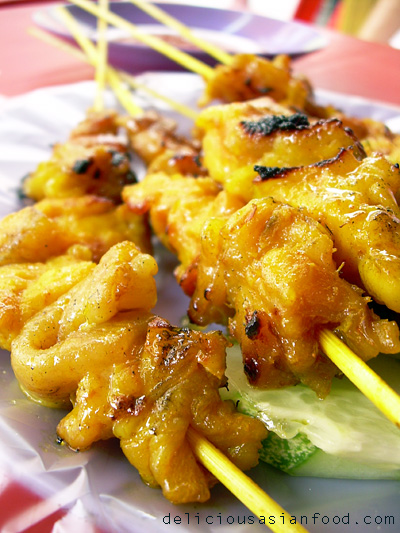
Satay, grilled skewered pieces of meat, was not supposed to be the highlight of that day. Rather, Portuguese Grilled Fish in downtown Chinatown / Petaling Street in Kuala Lumpur. It was the 15th May, 2008 and I finally got to me Bee Yinn of Rasa Malaysia after knowing and reading her blog for well over a year. As we were a little bit early that day, we decided to stop by at Zainal’s Satay which is located along the road leading to Petaling Street. If you are coming in into Petaling Street from the traffic light junction of KotaRaya, you will see Zainal’s Satay on the right hand side of the road. This was my first time eating Zainal’s Satay though I pass by this place almost daily.

As we were still intending to dig into the Portuguese Grilled Fish in a short while, we decided to place an order for 10 sticks of chicken satay (which costs RM0.60 each). I was used to eating Nyok Lan Satay (also known as Restoran Malaysia) in Kajang and would deem that the best so far but Zainal’s Satay is not too bad either. The satays were well marinated and comes slightly sweetish with a hint of tumeric (which also gives it a nice yellow tint). Thankfully, Zainal does not overly grill the satays till they become carbonised meat sticks. A little bit of carbon here and there is still acceptable 😀 Read the rest of this entry »

Dragon Fruit Jelly

Dessert April 24th, 2008

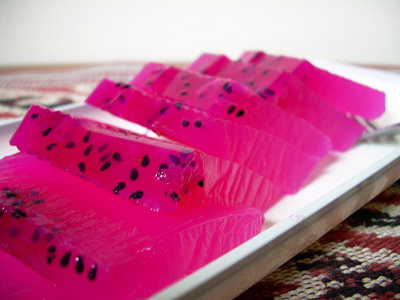
dragon fruit jelly

Dragon Fruit, also known as Pittaya, is commonly found in South East Asia especially Vietnam and Malaysia. This nutrition-packed fruit is believed to be native to south Mexico but has found itself to be a firm favourite over here in Malaysia. There is the white flesh variety and the other being the red flesh variety. Both come with tiny edible seeds not unlike kiwi fruit seeds. The dragon fruit is actually the fruit from a cactus plant and it has a bright red skin which can be peeled easily. I have previously written a post to document my visit to a dragon fruit farm (with pictures to boot!) and you might want to read that to know more about this fruit. Paris also took some beautiful dragon fruit pictures. Check it out if you are curious how these little dragons look like.

The dragon fruit is best eaten chilled but do take care with your clothing because the red coloured dye drips easily due to its juiciness. With its beautiful looks, it is no wonder that the dragon fruit is also used extensively to decorate cakes and in this instance, to add colour and taste to jelly (agar-agar). You don’t have to use a lot of dragon fruit to make one recipe of dragon fruit jelly. Nice to impress, easy to make.

This is my wife’s recipe for Dragon Fruit Jelly Read the rest of this entry »

Shortbread

Confectionery, Pastry April 21st, 2008

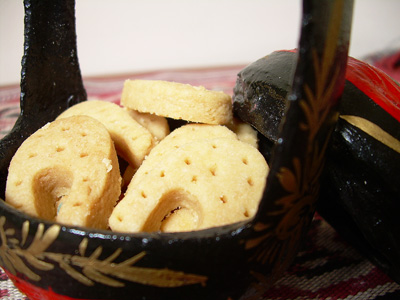
shortbread

When I was in England, I enjoyed eating Shortbread cookies, which are really popular in the British Isles. After all, the most famous Shortbread cookies are probably from Scotland especially the Walker’s Shortbread Cookies brand with the red tartan-like design. I have always thought that Shortbreads are difficult to make or bake. Afterall, it tastes great and has a nice semi-crumbly texture. That was until I was introduced to the Shortbread cookies which my mother-in-law baked over Chinese New Year recently.

Being her creative self, my mother-in-law baked this cute little Shortbread cookies in horse-shoe design and they were irresistible. We brought back a tin when we came back to Kuala Lumpur. This shortbread recipe was obtained by my mother-in-law about 20 years back but she did not attempt the recipe until the recent Chinese New Year and we were all impressed. When she gave me the recipe, the first thing that ran through my mind was “Is that all there is?”. It is so simple that even a beginner should be able to bake this and impress everyone else. Once you know how to bake this, you shouldn’t be keen to buy them off the shelves anymore. So, are you ready to try and impress?

This is my mother-in-law’s recipe for Shortbread Cookies Read the rest of this entry »

Popiah

Chinese April 14th, 2008

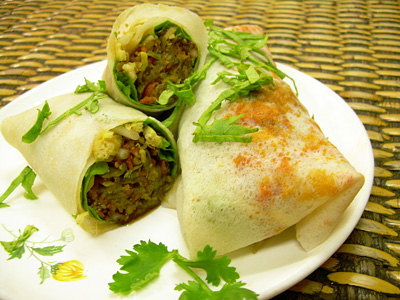
popiah

Popiah or Popia is a dish which my mum usually cook during Ching Ming Festival (April). I have yet to learn this dish because it is labourous and demanding. I must say that I am quite biased (and with good reasons) with Popiahs because to me, only mum’s Popiah is the best (and many others say so too). Her Popiah is unlike what is sold commercially as it contains more than 10 ingredients and the vegetables are painstakingly cut into fine slivers (just slightly thicker than a toothpick) rather than going through a shredding tool. It is no wonder then that relatives would “book” a few (or quite a lot) rolls of Popiah whenever they hear that she is making some.

According to mum, there can be no shortcut to making a good Popiah. The ones sold outside which are predominantly turnip and carrot filling just don’t do justice to how a good Popiah should be made and taste like. Even the sauce spread is sourced from southern Johor / Singapore - sweet flour sauce. I suppose this is because coming from Pontian, our tastebud is much influenced by what’s available down south. And that’s not all, Popiah skin which is specially ordered from the market is used rather than the ones sold in supermarket and kept frozen. Yes, we are very particular indeed in making a good tasting Popiah.

When I asked mum for the recipe for this Popiah, I was stuck actually because mum does not use a measuring type of recipe. Rather, just like how cooking is like second nature, the ingredients and seasoning are a matter of estimates or what we Malaysians call “agak-agak”. Hence, I had to help her to make a rough estimate of the ingredients used to make this delicious dish of Popiah. If you are game for a cooking challenge, try this Popiah recipe especially if you can get your hands on the exact ingredients available. You won’t be disappointed.

This is mum’s recipe for Popiah Read the rest of this entry »

blank
LinkWithin Related Stories Widget for Blogs