Browsing Category: "Vegetable"
 Cabbage Rice with Lap Cheong
This is my 3rd recipe for rice cooked in a rice cooker. Prior to this, I have a recipe for Chicken Rice as well as Long Bean Rice. This is another one of the vegetable rice recipes which can serve as a meal on its own.
Cabbage Rice with Lap Cheong (Chinese Sausages) is quite mild in flavour but sweet in taste. The sweetness comes from the cabbage. The type of cabbage we usually use is the chinese cabbage, which is white in colour and longish in shape rather than round. Try not to leave the rice uneaten overnight as I believe that the cooked cabbage does not withstand being kept overnight that well.
If you don’t have lap cheong, you can even substitute it with ham or even salami! Do experiment. As I have emphasised many times before in my recipes, you can actually experiment with the ingredients once you get the basic idea of how the dishes are cooked. The presentation of the rice in the picture above could be much better but the taste definitely is!
This is my recipe for Cabbage Rice with Lap Cheong (Chinese Sausages)
Ingredients
- 2 cups rice pre-soaked for 30 minutes (measured using the cup that comes with your rice cooker)
- About 400 grammes of chinese cabbage (shredded roughly)
- 400 grammes of belly pork (try to get the 3-layered pork. Remove skin)
- 5 to 8 pieces dried chinese mushrooms (pre-soaked till soft. Remove from water and cut to slivers but retain water for later use)
- 50 grammes of dried prawns / shrimps (pre-soaked for 5 minutes. Remove from water but retain water for later use)
- 3 to 5 lap cheong (remove skin and slice thinly diagonally)
- 5 cloves shallots (sliced thinly)
- 2 tablespoons of cooking oil (preferably palm oil)
- 3 bowls of water
Seasoning
- 4 teaspoons salt
- 1/2 teaspoon white pepper powder
- 2 teaspoon light soya sauce
- 2 tablespoon dark soya sauce
- A pinch of msg (optional)
Method
Bring water to boil. Add belly pork and let it boil till cooked. Remove pork. Cut into small pieces.
Heat oil in wok and fry shallots till golden brown. Remove fried shallots.
With remaining oil in wok, fry the cooked belly pork till beginning to brown. Remove pork. With remaining oil, fry the dried prawns and chinese mushrooms for 1 minute till fragrant. Add cabbage and put back the pork into the wok and continue to stir fry for 1 more minute. Add seasoning and a little bit of water (used to soak mushrooms / dried prawns) to keep it moist.
Add pre-soaked rice into the ingredients and stir well for 1 minute.
Transfer the ingredients into rice cooker and add water till it covers rice completely just like how you usually cook rice. Turn on the rice cooker. Check occasionally for water to dry out from the upper layer of the rice. Once that happens, place lap cheong on top of the rice, cover lid and wait for rice to cook completely.
Sprinkle fried shallots over rice before serving.


Sambal Belacan Ladies Finger
Dinner, Lunch, Vegetable November 8th, 2006
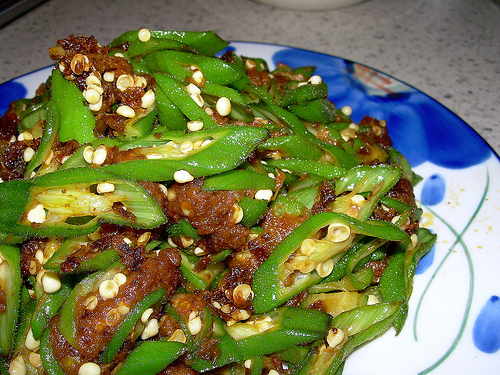 Sambal Belacan Ladies Finger
Ladies finger, also known as Okra, is a fibrous pod full of round white seeds. Packed with vitamins and minerals, it is often used in Asian cuisine especially in India. Back home in Malaysia, it is commonly added to Assam Fish or Curry Fish. It is also cooked as a dish of its own and I usually stir-fry it with belacan sambal.
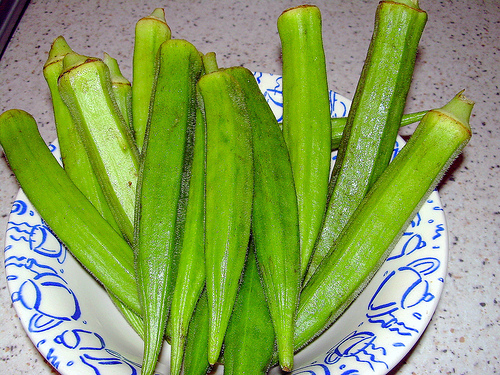 Ladies Finger or Okra
When choosing ladies finger, choose the younger pods which are usually lighter green in colour and smaller in size. Usually, the younger pods will have softer fur-like skin. These younger pods are more tender in texture and less fibrous.
And again, just like Kangkong Belacan, you should cook this dish using really high heat as you want to cook it in minimum time to preserve its juice.
This is my recipe for Sambal Belacan Ladies Finger
Ingredients
- Approximately 15 pieces of ladies finger (washed and sliced diagonally. Discard top / head)
- A pinch of sugar
- 50 ml warm water
- 2 tablespoons cooking oil (preferably palm oil)
Sambal belacan mix (pound / blended together)
- 50 grammes dried prawns / shrimps (pre-soaked for 10 minutes to soften)
- 20 grammes of belacan (buy from stores)
- 5 to 8 cloves garlic
- 5 to 8 cloves shallots
- 3 to 5 red chillis (remove seeds if you want the sambal to be less hot)
Method
Heat oil on wok at medium heat. Stir-fry the sambal belacan mix for about 2 minutes.
Increase heat to high and add ladies finger and sugar. Stir well for about 2 minutes or till the ladies finger is to your desired softness. Add a little water at a time if sambal belacan mix beginning to burn. As the sambal belacan mix contains dried prawns and belacan which are salty in itself, it may not be necessary to add salt.
Stir-Fried Pea Sprouts with Garlic
Chinese, Dinner, Lunch, Vegetable November 6th, 2006
Pea-Sprouts are also known as “Tou Miau” in Mandarin. Rich in vitamins and minerals, it is considered one of the easiest vegetable to stir-fry. Popular in many Chinese restaurants, the prices of these pea-sprouts have risen over the years due to its high demand.
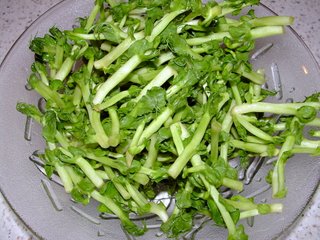 Fresh Pea-Sprouts
When cooking this dish, it is important to have the wok heated at high as you need to cook the pea-sprouts in minimum time to preserve its nutrients and to ensure that the juices are retained in the sprouts. Else you will have a flooded dish!
This is my recipe for Stir-Fried Pea Sprouts with Garlic
Ingredients
- 300 grammes pea-sprouts (rinse with water to remove dirt prior to cooking)
- 5 to 8 cloves garlic (chopped finely)
- 2 tablespoons cooking oil (preferably palm oil)
Seasoning
- 1 1/2 teaspoons oyster sauce
- Salt to taste
- A dash of white pepper powder
Method
Heat wok till wok starts to smoke.
Add oil followed by garlic. Give the garlic a few quick stir and add the pea-sprouts.
Continue to stir-fry briskly whilst adding seasoning. Cook until pea-sprouts begin to wilt to your desired softness or reduced by 1/2 in bulk. Add one or two tablespoons of warm water if you prefer some gravy.
Stir-Fried Kai-Lan Stems with Pork and Mushrooms
Dinner, Lunch, Vegetable November 1st, 2006
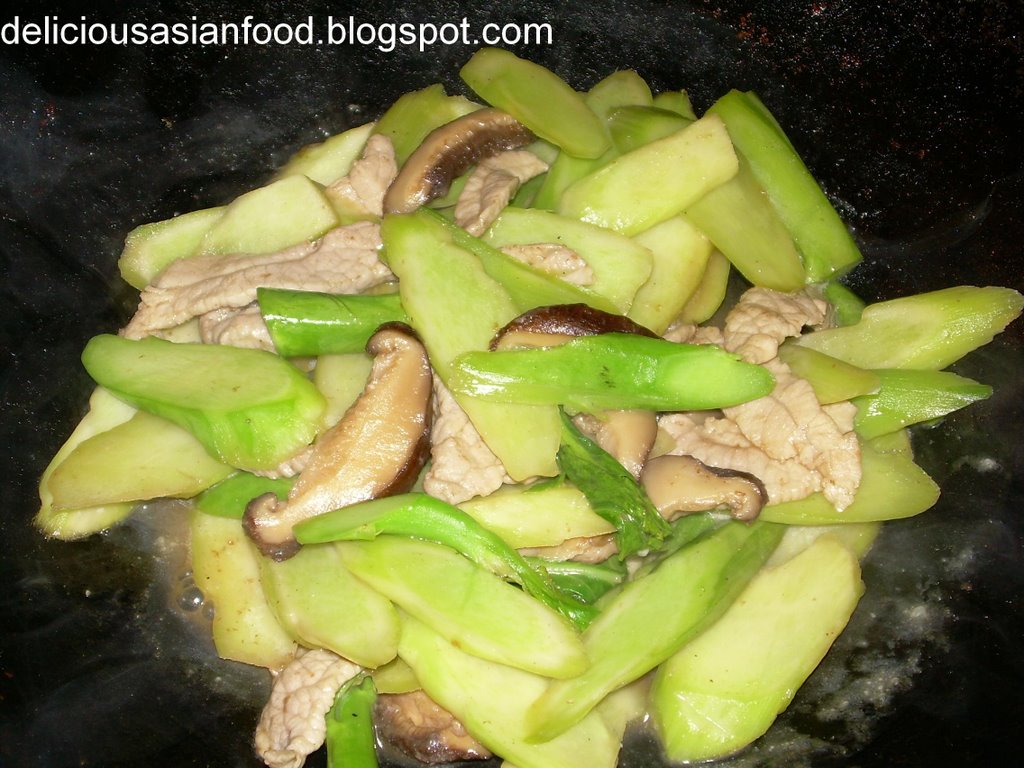 Stir-Fried Kai-Lan Stems with Pork and Mushrooms
“Oh no! Not another recipe with mushrooms!” Ha! Ha! Well, can’t help it when I have a lot of mushrooms at home. Chinese dried mushrooms to be precise. But anyway, the mushrooms here are the supporting act. The main actor is the Kai Lan stems.
According to the Wikipedia, Kai-lan, also known as Chinese broccoli or Chinese kale, is a slightly bitter leaf vegetable featuring thick, flat, glossy blue-green leaves with thick stems and a small number of tiny, almost vestigial flower heads similar to those of broccoli. As a group of Brassica oleracea kai-lan is of the same species of plant as broccoli and kale. Its flavor is very similar to that of broccoli, though not identical, being a bit sweeter.
In this recipe, I use the kai-lan stems. These are usually imported and sold in supermarkets. Unfortunately, I forgot to take a picture of it prior to cooking. What you get is a stem roughly 15 to 20cm long and with very little or no leaf. It tastes much sweeter than the leaves in “normal” the normal kai-lan vegetable. I am told that this variety of kai-lan is grown specifically for its crunchy and sweet tasting stem.
The ideal way to cook this stem is to stir-fry it with medium or large sized prawns which have been deveined and cut “butterfly style”. If you are rich enough, you can consider adding scallops! As I don’t have any prawns at home when I decided to cook this dish and I am not rich enough to consider scallops, I used pork and mushrooms as the supporting cast.
This is my recipe for Stir-Fried Kai-Lan Stems with Pork and Mushrooms
Ingredients
- 3 to 5 kai-lan stems (lightly scrape the layer of skin from the stem and slice diagonally)
- 50 grammes of pork tenderloin (sliced thinly)
- 2 to 3 pre-soaked chinese mushrooms
- 4 cloves garlic (chopped finely)
- 1 tablespoon of palm oil
- 1/2 cup warm water
- 2 teaspoons cornflour mixed with 1/2 cup water to make corn starch
Marinade for pork tenderloin
- 2 teaspoon light soya sauce
- a pinch of white pepper powder
- 1 teaspoon corn flour
Seasoning
- 1 tablespoon oyster sauce
- Salt to taste
- 2 teaspoons chinese cooking wine (optional)
- A dash of white pepper powder
Method
Marinade pork tenderloin for 30 minutes.
Heat oil in wok and fry garlic till beginning to brown. Remove garlic from oil.
Add pork tenderloin and chinese mushrooms into remaining oil in wok and stir fry for 1 minute. Add kai-lan stems and pre-fried garlic and stir-fry briskly for 1 minute. Add one or two teaspoons of warm water to prevent burning.
Add seasoning (except chinese cooking wine) followed by remainder of water and cover lid. Allow to cook for 1 to 2 minutes whilst checking occasionally for drying out of gravy.
Once the stems have more or less turned to a darker colour, add chinese cooking wine and stir well. If the sauce is too thin to your liking, add a little bit of corn starch to thicken it.
Dish out and serve with white rice.


 . I admit - this is not a ‘weight watcher’...