Browsing Category: "Pork"
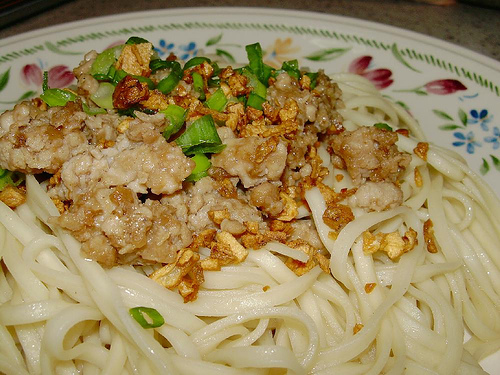
Kolok Mee refers to a dry version of noodles originating from Sarawak (I stand corrected). It is sometimes known as Sarawak Kolo Mee or simply Kolok Mee. It takes a few platefuls of this noodles before it grows on you. Perhaps it has to be due to the fact that it is rather plain looking compared to other more colourful noodle dishes. However, once you grow to like it, it can be addictive.
What I have cooked here is my home-made version of the Kolok Mee. Not the making of the noodles but rather, the mixture of sauces which came up with the Kolok Mee taste. It can be a tad saltish to some, so you might want to go easy on the amount of seasoning used here. As for the noodles, I am using dried instant noodles bought from Sitiawan, made by the Foo Chow community. The texture (which is a bit like pasta, but stiffer) is quite suitable for this seasoning…almost like Kampua Noodles. Wantan noodles are also suitable, especially the curly stringy type. Yellow noodles are not suitable. As I don’t have char siew available, I have decided to just have minced pork only for the topping. Try this recipe if you can and adjust the measurements according to your preference.
This is my recipe for Kolok Mee (serves 3 portions)
Ingredients
- 3 pieces of instant noodles
- 100 grammes of minced pork
- 1/2 bulb of garlic (finely chopped)
- spring onions for garnishing (chopped finely)
- 6 tablespoons of palm oil
Seasoning (for 3 servings)
- 3 teaspoons of fish sauce
- 1/3 teaspoon of salt
- 1 teaspoon of light soya sauce
- 1/3 teaspoon of monosodium glutamate
- a couple of dashes of white pepper powder
Marinade (for minced pork)
- 2 teaspoons of fish sauce
- 1 teaspoon of light soya sauce
- a couple of dashes of white pepper powder
- 1 teaspoon of corn flour / potato flour
Method
Marinade minced pork for at least 1 hour.
Bring a pot of water to boil. Add instant noodles and cook till almost done. Remove noodles from pot using a net or colander and run it through cold or tap water. Return noodles to boiling water to heat it up again and thereafter, drain the noodles after 30 seconds. Set aside.
Heat oil in wok using medium high heat. Fry garlic till golden brown. Remove fried garlic and set aside.
Scoop up oil into a bowl leaving about 2 tablespoons of oil remaining in the wok. Increase heat to high and stir fry minced pork till completely cooked (about 2 minutes). Sprinkle some water whilst stir frying to prevent burning. The minced pork should be just moist after cooking and not soaking in gravy. Remove cooked minced pork and set aside.
In a large bowl, add all the seasoning and stir well. Add cooked instant noodles and stir till evenly coated by the seasoning. Separate the noodles onto three serving plates. Add some cooked minced pork and garnish with fried garlic and spring onions.
Technorati Tags: recipe, chinese, malaysian, sarawak, kuching, noodles, mee, food


Wo Tieh (Shallow Fried Dumplings)
Appetiser, Chinese, Pork, Snacks March 23rd, 2007
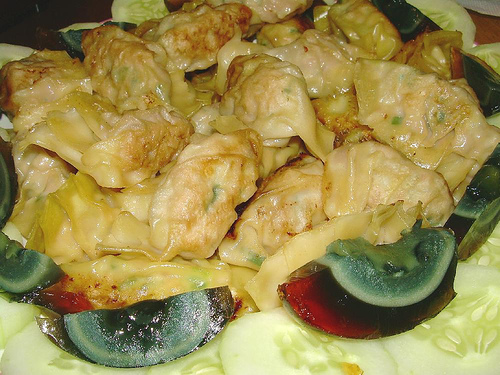
Wo Tieh is also known as Shallow Fried Dumplings. Some call them Pot Stickers because they are fried on shallow pans. These are not the same as wantons because they use thicker skin and is a flatter, more oblate, double-saucer like shape (similar in shape to ravioli), and is usually eaten with a ginger-soy-vinegar dipping sauce (and/or hot chilli sauce); while a wonton has a thinner skin, is sphere-shaped, and is usually served in broth. In the picture above, the wo tiehs are arranged in the middle (simply arranged with no artistic intention) with sliced century eggs and cucumbers. They go well together.
My sister cooked this dish for Chinese New Year Eve’s Dinner and it was a great appetiser as well as accompaniment to the steamboat fare we had.
This is my sister’s recipe for Wo Tieh (Shallow Fried Dumplings)
Ingredients
- 200 grammes round cabbage (chopped finely)
- 400 grammes semi-lean pork (mince it)
- 50 grammes of chinese chives (chopped finely)
- 200 grammes of prawns (chopped)
- 3 cm ginger (chopped finely)
- 3 cloves garlic (chopped finely)
- 50 pieces of dumpling skin (choose the thicker ones, approximately 6 to 8 cm diameter and round shaped)
- 400 ml warm water or chicken stock
- Corn starch (mix 5 tablespoons water to 2 tablespoons corn flour to seal dumpling skin)
- Oil for frying (palm oil)
Seasoning
- 2 tablespoons chinese cooking wine
- 3 tablespoons light soya sauce
- 2 tablespoons sesame oil
- 1 teaspoon white pepper powder
- 1 teaspoon salt
Dip
- Thinly julienned ginger
- Black vinegar
- a sprinkle of sugar
Method
In a large bowl, mix cabbage, pork, chives, prawns, ginger, garlic and seasoning. Stir and mix well forming one lump. Cover the mixture with cling film and set it aside for at least 1 hour.
To prepare dumplings, place one piece of dumpling skin on plate or table or hold spread out on one hand. Take one tablespoon of mixture and place it in center of skin. Using your finger, spread corn starch on edge of skin. Fold wrapper in half over the mixture and pinch centre of one edge. At the other end, make pleats to gather the mixture in the middle of the dumpling skin. Ensure that pleats at edges are tightly sealed and set the dumpling on a plate with sealed side up. Cover with moistened towel and work on the other dumpling skins till all mixture used up.
Heat a non-stick pan on high and lightly brush with oil. Fry the dumplings with the sealed side up by arranging as many dumplings together without touching each other. Fry till the bottoms start to brown and add a little water / chicken stock up to about 1 cm high. Cover with lid and allow water or stock to dry out. Continue to add same amount of water / stock and repeat process to cook till dumplings are firm (about 10 minutes). Finally, remove lid and brown the dumplings a little bit more (by now, you can brown the sides because the dumplings are firm enough and will not open up) for 1 minute.
Dish out and serve hot with dip.
Technorati Tags: recipe, chinese, dumpling, prawns, pork, chicken, potstickers, appetiser
Stir Fried Leek with Roast Pork
Chinese, Dinner, Pork, Vegetable March 15th, 2007
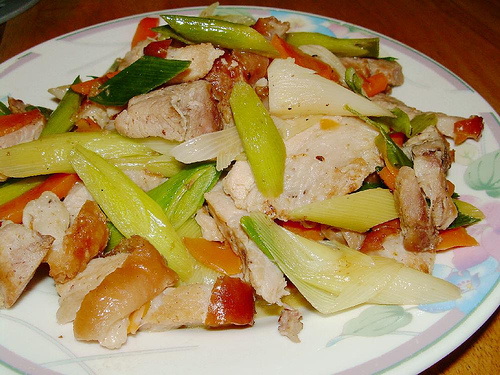
What do you do with left-over Roast Pork? Well, you can stir fry them with leeks. The combination of slightly saltish Roast Pork with the slightly sweet leek makes this dish very delicious indeed. It is pretty simple really because your only aim whilst cooking this dish is to stir fry the leek till it softens. As for taste, the roast pork will give the dish enough “seasoning” on its own, though you can actually add a little bit of oyster sauce for more “kick” out of it. The edible portions of the leek are the white onion base and light green stalk. Cut off the root and cut the leek into not more than 6 cm lengths.
This is my recipe for Stir Fried Leek with Roast Pork
Ingredients
- 1/3 plateful of roast pork (cut into small pieces)
- 1/2 plateful of leek (cut into not more than 6cm lengths)
- 1/2 piece of carrot (sliced)
- 2 cloves garlic (chopped)
- About 50 to 100ml warm water
- 1 tablespoon of palm oil
Seasoning
- 2 teaspoons oyster sauce
- A couple of dashes of white pepper powder
- 1 tablespoon of chinese cooking wine
Method
Heat oil in wok. Fry garlic for 15 seconds and add leeks and carrot. Stir fry briskly for about 15 seconds.
Add the roast pork and seasoning (except chinese cooking wine) followed by 50 ml water. Stir well and bring water / sauce to boil. Close lid and let it continue to cook. Check occasionally to ensure sauce does not dry out. Add more water gradually (not more than 50 ml at a time) and cook till leek is limp and soft enough to your liking.
Add chinese cooking wine and stir well prior to dishing out. This dish compliments steamed white rice well.
Chinese Roast Pork
Chinese, Dinner, Lunch, Pork March 13th, 2007
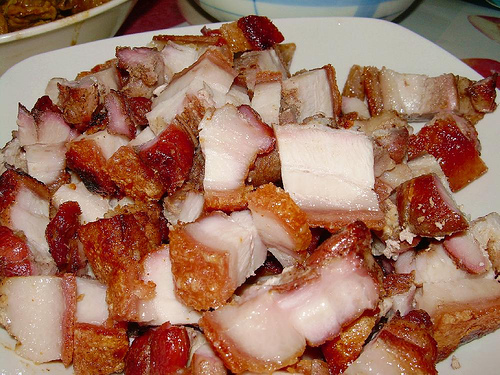
My mother-in-law made some chinese roast pork when we were in Kuching for the Chinese New Year. Chinese roast pork here refers to siew yuk (in cantonese) or sio bak (in hokkien). With a crispy crackling roasted skin and semi-tender meat, you can be assured of spoonfuls after spoonfuls of rice to go with it. No wonder I put on weight over Chinese New Year!
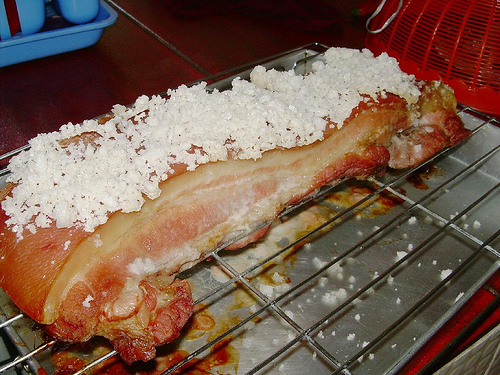
In Malaysia, there are many roast pork rice stalls around. It is very popular. A plate of white / fragrant rice with a few cuts of these roast pork and a couple of pieces of sliced cucumbers can cost about USD1.00 on the average depending where you go to. Very cheap, right? Absolutely.
This is my mother-in-law’s recipe for Chinese Roast Pork and the measurements are approximate only because she cooks it more by feel than using a strict recipe to follow.
Ingredients
- 1 piece of pork belly weighing approximately 1 kg
- 3 tablespoons of coarse / rock salt
- 2 tablespoons of fine salt
- 1 tablespoon of five-spice powder
Method
Clean pork belly and pat dry with kitchen towel. Rub fine salt and five-spice powder on meat. Rub coarse salt on skin.
Heat up oven at gas mark 4 (about 180 degrees celcius). Place pork belly on a rack with a tray underneath to catch dripping oil. Roast the pork belly for at least 30 minutes and until the coarse salt crystalises just like in the picture above.
Remove the salt crystals and continue to roast till the skin is crispy. (Alternatively, what my mother-in-law did was to remove the pork belly and fry the pork belly in a wok with skin-downwards and without oil on medium heat till the skin turned crispy)
I have heard of some of the chinese roast pork recipe which called for the pork belly skin to be poked with a sharp knife so as to enable the fat to ooze out faster during roasting. You can try this additional step as well prior to rubbing the coarse salt.
Cut into small bite sizes prior to serving.