Browsing Category: "Pork"
Steamed Japanese Tofu with Minced Pork
Pork, Tofu September 3rd, 2007
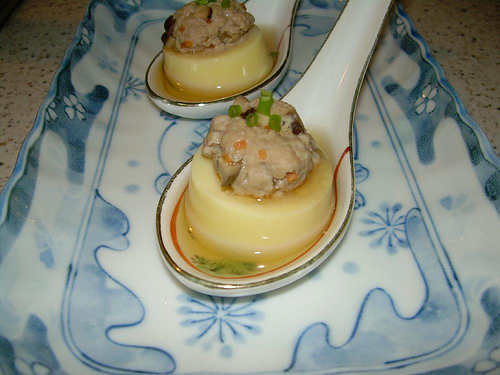
This was a quick dish which I whipped up last Thursday. I had gotten home slightly early and decided to cook something simple based on what I have in my fridge. I still had 1 more tube of Japanese Tofu in the fridge and a small piece of pork tenderloin which would be easy to defrost. With a little bit of mushrooms and carrots, this is what I cooked. A simple, yet delicious dish of tofu.
I decided to place a piece of tofu each on soup spoons just for the thrill of it. It’s quite handy as you can just pop them into your mouth. Otherwise, just arrange the tofu onto a suitable plate for steaming. My daughter was going ooh! and ahh! and was delighted by the “cuteness” of this dish. Perhaps you might want to try this to impress your little ones as well.
This is my recipe for Steamed Japanese Tofu with Minced Pork Read the rest of this entry »


Kueh Chap
Chinese, Food review, Pork, Soup August 2nd, 2007
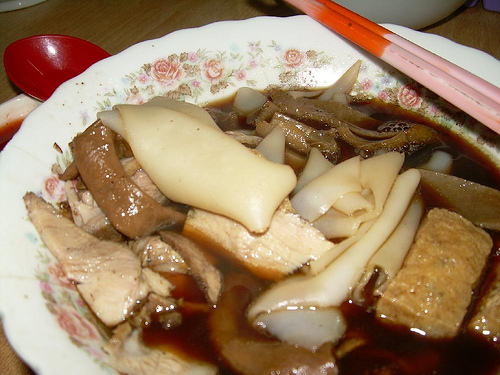
In Hong Kong, the movie industry has its 4 Heavenly Kings to describe the 4 most popular singers. For me, I have my 4 Heavenly Kings to describe my 4 must-eat hawker dishes in Kuching. Kueh Chap is one of the 4. The others being the Sarawak Laksa, Kolok Mee and Tomato Kuey Teow.
Kueh Chap, I believe, is hokkien for the word “Cake” and “Mixed”. The “cake” or kueh denotes the use of thicker than usual kuey teow (rice flour cake - which is like lasagna) whilst “mixed” or chap probably describes the use of a mixture of pork parts in the dish. In Penang, Singapore and Johor Bahru, I believe they use duck parts as well. In Kuching, it is almost exclusively pork. Read the rest of this entry »
Lap Cheong Omelette
Chinese, Egg, Pork July 30th, 2007
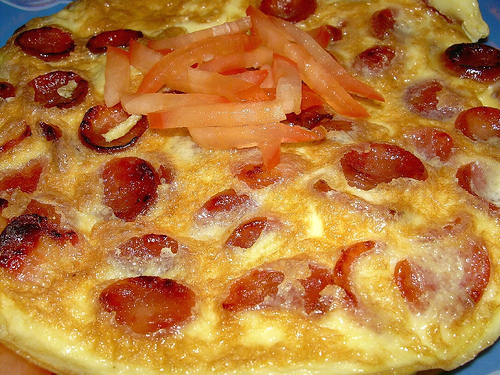
This will be two omelette recipes in succession, the previous being fried oyster omelette. Lap cheong is cantonese for sausages. This is uniquely chinese and is usually available in chinese stores in western countries or at the market or dried produce stores in parts of Asia.
Lap cheong has a distinct sweet taste and the level of saltiness depends on the amount of salt put in by the manufacturer. There are many ways of eating this, fried, steamed or cooked with other dishes, which in this case, is used as the ingredient for an omelette. Lap cheong is, on a visual inspection, probably 70% fat and 30% meat content. Therefore, you don’t really need to use much oil when cooking it. As for storage, you can keep it in the fridge for a couple of months (which I have done). Definitely handy to use when you want to cook a meal in a jiffy.
This is the recipe for Lap Cheong Omelette
Ingredients
- 2 pieces of lap cheong (sliced thinly, just like salami)
- 2 large eggs (beaten)
Method
If you are using a wok, heat up 1 teaspoon of oil. Otherwise, it is preferred to use a non-stick frying pan.
Fry lap cheong for 30 seconds until aromatic. Pour beaten eggs over it and reduce to low heat to allow the underside of the eggs to cook.
Flip egg over once the upper part starts to cook. Increase heat and allow to fry for 30 seconds before serving. Garnish to your liking. There is no need to add seasoning as the lap cheong is full bodied in taste.
Minced Pork Balls with Preserved Black Beans
Beans, Pork July 4th, 2007
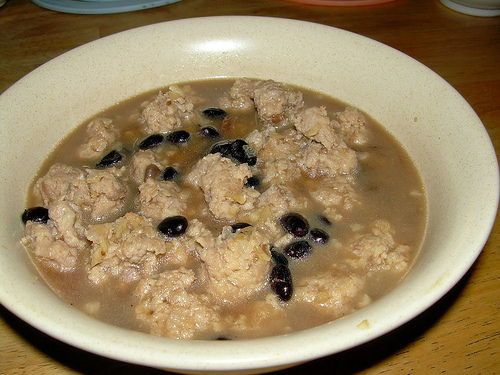
Preserved Black Beans, Fermented Black Beans and Salted Black Beans all mean the same thing, namely black beans which have been preserved in a salty solution and are usually sold in glass jars. The taste is naturally salty and usually, only a small portion is used.
This dish was oft cooked by mum for lunch during my schooling days and it tastes delicious with plain white porridge or even sweet potato porridge. Preparation and cooking should be less than 30 minutes as it only involved mincing the pork and cooking it with the preserved black beans. You’ll be amazed how easy it is to whip up a great tasting dish in a jiffy.
This is mum’s recipe for Minced Pork Balls with Preserved Black Beans Read the rest of this entry »