Browsing Category: "Chinese"
Stir Fried Leek with Roast Pork
Chinese, Dinner, Pork, Vegetable March 15th, 2007
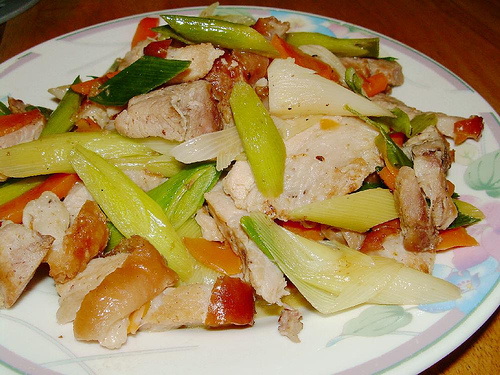
What do you do with left-over Roast Pork? Well, you can stir fry them with leeks. The combination of slightly saltish Roast Pork with the slightly sweet leek makes this dish very delicious indeed. It is pretty simple really because your only aim whilst cooking this dish is to stir fry the leek till it softens. As for taste, the roast pork will give the dish enough “seasoning” on its own, though you can actually add a little bit of oyster sauce for more “kick” out of it. The edible portions of the leek are the white onion base and light green stalk. Cut off the root and cut the leek into not more than 6 cm lengths.
This is my recipe for Stir Fried Leek with Roast Pork
Ingredients
- 1/3 plateful of roast pork (cut into small pieces)
- 1/2 plateful of leek (cut into not more than 6cm lengths)
- 1/2 piece of carrot (sliced)
- 2 cloves garlic (chopped)
- About 50 to 100ml warm water
- 1 tablespoon of palm oil
Seasoning
- 2 teaspoons oyster sauce
- A couple of dashes of white pepper powder
- 1 tablespoon of chinese cooking wine
Method
Heat oil in wok. Fry garlic for 15 seconds and add leeks and carrot. Stir fry briskly for about 15 seconds.
Add the roast pork and seasoning (except chinese cooking wine) followed by 50 ml water. Stir well and bring water / sauce to boil. Close lid and let it continue to cook. Check occasionally to ensure sauce does not dry out. Add more water gradually (not more than 50 ml at a time) and cook till leek is limp and soft enough to your liking.
Add chinese cooking wine and stir well prior to dishing out. This dish compliments steamed white rice well.


Chinese Roast Pork
Chinese, Dinner, Lunch, Pork March 13th, 2007
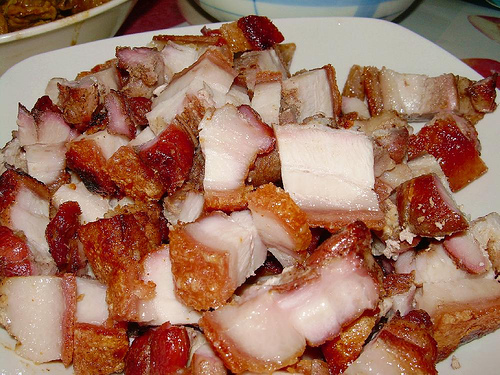
My mother-in-law made some chinese roast pork when we were in Kuching for the Chinese New Year. Chinese roast pork here refers to siew yuk (in cantonese) or sio bak (in hokkien). With a crispy crackling roasted skin and semi-tender meat, you can be assured of spoonfuls after spoonfuls of rice to go with it. No wonder I put on weight over Chinese New Year!
In Malaysia, there are many roast pork rice stalls around. It is very popular. A plate of white / fragrant rice with a few cuts of these roast pork and a couple of pieces of sliced cucumbers can cost about USD1.00 on the average depending where you go to. Very cheap, right? Absolutely.
This is my mother-in-law’s recipe for Chinese Roast Pork and the measurements are approximate only because she cooks it more by feel than using a strict recipe to follow.
Ingredients
- 1 piece of pork belly weighing approximately 1 kg
- 3 tablespoons of coarse / rock salt
- 2 tablespoons of fine salt
- 1 tablespoon of five-spice powder
Method
Clean pork belly and pat dry with kitchen towel. Rub fine salt and five-spice powder on meat. Rub coarse salt on skin.
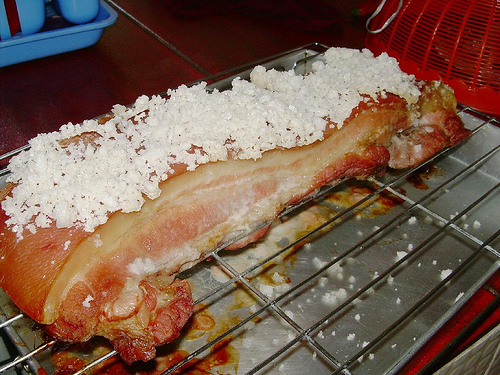
Heat up oven at gas mark 4 (about 180 degrees celcius). Place pork belly on a rack with a tray underneath to catch dripping oil. Roast the pork belly for at least 30 minutes and until the coarse salt crystalises just like in the picture above.
Remove the salt crystals and continue to roast till the skin is crispy. (Alternatively, what my mother-in-law did was to remove the pork belly and fry the pork belly in a wok with skin-downwards and without oil on medium heat till the skin turned crispy)
I have heard of some of the chinese roast pork recipe which called for the pork belly skin to be poked with a sharp knife so as to enable the fat to ooze out faster during roasting. You can try this additional step as well prior to rubbing the coarse salt.
Cut into small bite sizes prior to serving.
Sugar Snap Peas with Tiny Anchovies
Chinese, Dinner, Lunch, Vegetable March 9th, 2007
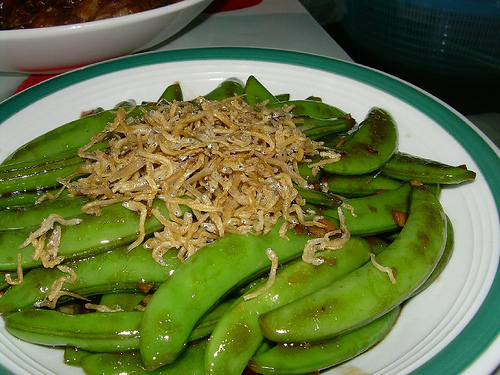
After all the excesses from the last fattening recipe, it is time to go for moderation a bit. Hence, this recipe of Sugar Snap Peas with Tiny Anchovies. And these tiny anchovies are probably the smallest fish that is served on people’s plates. For hokkiens, we call them “ghun he”. I don’t know what they are called in English…suffice to say, they only measure on the average 10 - 15mm long.
So, this recipe calls for sugar snap peas and tiny anchovies plus the compulsory garlic and oil. Seasoning? Just oyster sauce will do. Simple, isn’t it? That’s what I like about this dish. The sugar snap peas are sweet (why else use the word sugar?) and the tiny anchovies lend a hint of saltiness to it. To prepare the sugar snap peas, you must remove strings which run across the pod. To do this, pinch the very tip of the pea, getting hold of the string. Pull the string up the straightest side toward the stem end; pinch off the stem end and continue pulling the string until there is no more.
This is the recipe for Sugar Snap Peas with Tiny Anchovies
Ingredients
- 200 grammes or 1 bowl of sugar snap peas
- 2 tablespoons tiny anchovies (give a quick very rinse of water to get rid of dust / dirt)
- 4 cloves garlic (chopped)
- 2 tablespoon of cooking oil (palm oil)
- Warm water for sprinkling
Seasoning
- 1 tablespoon oyster sauce
Method
Heat oil in wok. Add tiny anchovies and reduce heat to medium. Fry the anchovies till golden brown. Remove anchovies and set aside to cool.
With remaining oil in wok, add garlic and fry till aromatic. Increase heat to high and add sugar snap peas. Stir fry continually for 2 to 3 minutes whilst adding oyster sauce. Sprinkle some warm water occasionally to prevent drying up.
Serve on plate and sprinkle fried anchovies on top of the sugar snap peas.
Technorati Tags: sugar snap peas, peas, anchovies, recipe, chinese, vegetable
Kong Bak with Ho Hup Pau
Chinese, Dinner, Pork March 6th, 2007
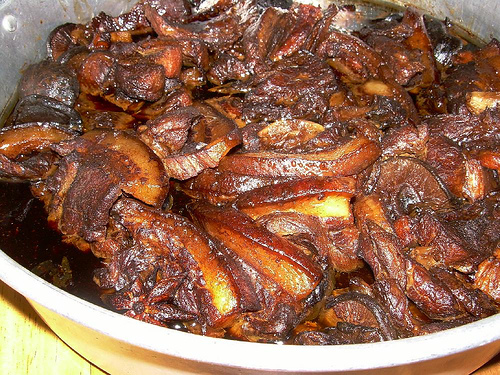
What is Kong Bak? I suppose you can generally call it Pork Belly Slices in Dark Sauce. What sets it apart is that it is wedged between a bun called Ho Hup Pau (Pau meaning Bun) and eaten just like a kebab. Simcooks has been pestering (reminding, ahem!) me for this recipe. She has a good looking pork belly recipe but my family method of cooking is different. There are actually 3 steps to cooking this dish.
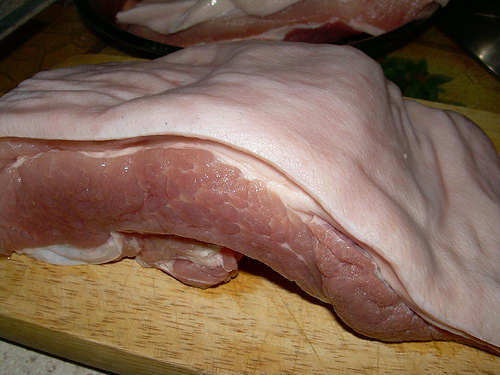
The first step involves “blanching” the pork belly in boiling water for approximately 30 seconds. This will make the meat slightly cooked on the outer side and makes it firm. Otherwise, it is rather wobbly. I think it also removes a bit of unpleasant “porky” smell or taste.
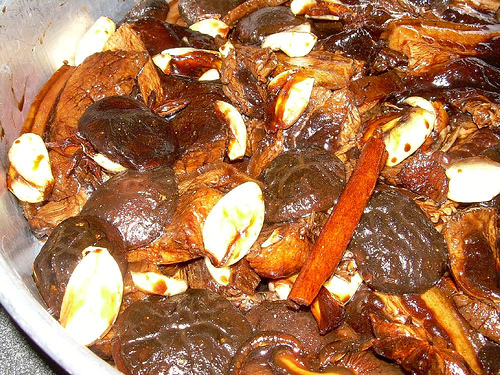
The next step is to prick the pork belly skin with the pointed end of a knife. A fork won’t do unless you’ve got a really sharp fork. Prick it just like how you would prick the skin of a potato. After pricking the skin, fry the whole piece of pork belly for about 20 seconds on each side (skin side and meat side). Then slice the pork belly before marinating it and followed by steaming.
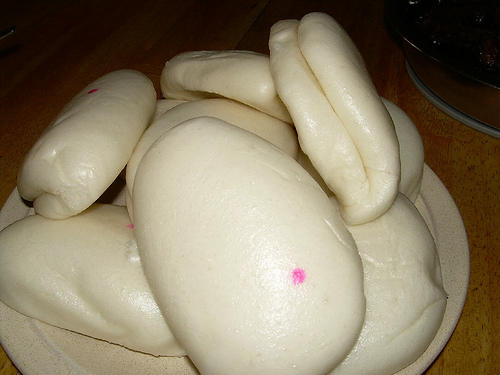
It all sounds like an awful lot of work to do but trust me, it is actually VERY SIMPLE. And you will absolutely love it to bits as long as you don’t mind the smooth as silk fat and meat melting in your mouth as your chomp on the sweet-tasting bun. I am not kidding, the fat can actually melt in the mouth! We had this for Chinese New Year’s Eve and breakfast the next day. Superlicious! Oh by the way, you can get the buns from the cold storage section of bigger supermarkets.
This is my family recipe for Kong Bak with Ho Hup Pau
Ingredients
- 1 kg of pork belly (approximately 1 feet long x 3 inches wide) - cut into 2 pieces for ease of blanching and frying
- 20 pieces of chinese dried mushrooms (pre-soaked till soft, remove stalk)
- Water for blanching
- Oil for frying (semi-deep frying)
Marinade
- 5 tablespoons dark soya sauce
- 1 tablespoon oyster sauce
- 3 tablespoons sugar
- 1 1/2 tablespoons tomato ketchup
- 2 teaspoons white pepper powder
- 2 teaspoons five spice powder
- 2 teaspoons salt
- 1 1/2 tablespoons chinese cooking wine
- 3 to 5 cinnamon sticks
- 5 to 8 pieces of star anise
- 2 whole bulbs of garlic
Method
Bring water to boil in wok or pot and blanch the pork belly for approximately 30 seconds. You will notice that the meat is slightly cooked and the skin is slightly toughened. Remove from water and drain. Prick the skin with the sharp end of a knife or sharp fork.
Next, heat up oil in wok and fry the pork belly 20 seconds on each side (skin side and meat side). Remove and place on a rack for to cool and to let excess oil drip. You will notice that the meat and skin is now slightly browned and the whole piece of pork belly is slightly firm.
Cut the pork belly into 1 to 1.5cm-width slices. Place the pork belly slices together with mushrooms in a suitable container and marinade them with the marinate above for at least 2 hours or longer.
After marinating, arrange the pork belly slices on a tray (suitable for steaming) and pour all the marinade over it. Steam it for at least 1 1/2 hours.
To serve, steam to heat up the buns. Prise open the bun just like a kebab bun and place a slice of the kong bak (belly slices) and mushroom into the bun. Savour the most delicious pork belly slice you’ll ever find! I’m drooling just writing about this!