Author Archive
Lap Cheong Omelette
Chinese, Egg, Pork July 30th, 2007

This will be two omelette recipes in succession, the previous being fried oyster omelette. Lap cheong is cantonese for sausages. This is uniquely chinese and is usually available in chinese stores in western countries or at the market or dried produce stores in parts of Asia.
Lap cheong has a distinct sweet taste and the level of saltiness depends on the amount of salt put in by the manufacturer. There are many ways of eating this, fried, steamed or cooked with other dishes, which in this case, is used as the ingredient for an omelette. Lap cheong is, on a visual inspection, probably 70% fat and 30% meat content. Therefore, you don’t really need to use much oil when cooking it. As for storage, you can keep it in the fridge for a couple of months (which I have done). Definitely handy to use when you want to cook a meal in a jiffy.
This is the recipe for Lap Cheong Omelette
Ingredients
- 2 pieces of lap cheong (sliced thinly, just like salami)
- 2 large eggs (beaten)
Method
If you are using a wok, heat up 1 teaspoon of oil. Otherwise, it is preferred to use a non-stick frying pan.
Fry lap cheong for 30 seconds until aromatic. Pour beaten eggs over it and reduce to low heat to allow the underside of the eggs to cook.
Flip egg over once the upper part starts to cook. Increase heat and allow to fry for 30 seconds before serving. Garnish to your liking. There is no need to add seasoning as the lap cheong is full bodied in taste.


Fried Oyster Omelette - Oh Chien
Chinese, Egg, Seafood July 27th, 2007
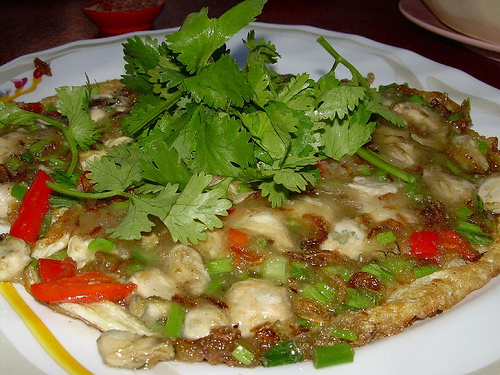
Fried oyster omelette (called Oh Chien in Hokkien) is one of my favourite dishes at the hawkers in Malaysia. In Malaysia alone, there are a few types of fried oyster omelette. In Kuching and Pulau Pangkor, the omelette is crispy much like crackers whilst in Pontian, Melaka and Penang, it is slightly soft and sticky (owing to the use of potato starch).
Before you start going “ooh-aah, Pablo can cook!”, let me tell you that this is what I ate in Pontian a couple of months ago and “No”, I did not cook this. I might try cooking it one day if I can get my hands on fresh small-sized oysters. The other ingredients in this dish are pretty much standard and easy to find. I have eaten fried oyster omelette which has medium or slightly larger sized omelette but found them a tad too overpowering in the taste of the oyster. Besides, I think using larger sized oysters are a waste. Better have them fresh with a squeeze of lemon instead.
If at all you can find the ingredients, why not try this Fried Oyster Omelette recipe by Amy Beh? Read the rest of this entry »
Lek Tau Suan
Dessert July 25th, 2007
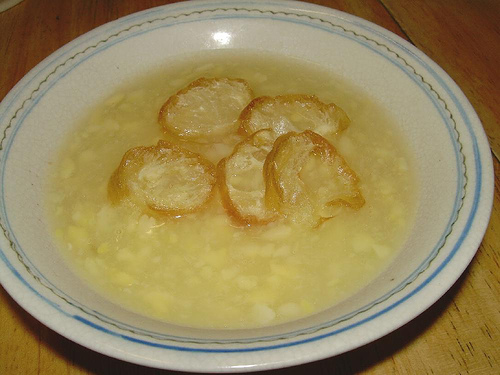
Lek Tau Suan is hokkien word meaning “Green Bean Pearl”. Actually, the “green beans” are mung beans and they are purchased in split form minus the skin. This dessert is quite popular amongst the hokkien community and is usually eaten hot / warm with some thinly sliced yau char kueh (fried chinese crullers). I usually have 2 bowls in one go and yes, it is one of my favourite desserts.
This dessert is sweet whilst the yau char kueh adds a salty hint to the taste. Usually the softer yau char kueh is used as many people like it to absorb the dessert much like a sponge. Without the yau char kueh, somehow, it is not complete. If you can get your hands on all these ingredients, try this out on a weekend and impress your friends or family 
This is my mum’s recipe for Lek Tau Suan Read the rest of this entry »
Spicy Beef
Beef July 23rd, 2007
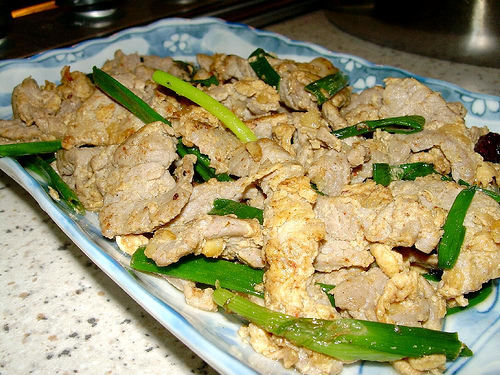
I don’t know what to call this dish and will settle for the name Spicy Beef. It is going to be rather lengthy if I would call it based on what I did to the beef. I had the inspiration to cook this based on what I had in Golden Mansion Restaurant in Melaka, Malaysia. What I ate in the said restaurant was essentially tender pieces of beef lightly boiled in steamboat. It tastes really good and I was figuring out what went into the marinade. With some suspicion here and there, I reckoned that it involved the use of preserved bean curd and sesame oil. Since I don’t have steamboat feasts at home on a regular basis, I decided to give it a stir-fry instead.
The stir-fry turned out really nice and “exotic”. It has a slightly spicy taste to it due to the use of the preserved bean curd. The preserved bean curd and fragrance of sesame oil matched well with the natural taste of the tender slices of beef. I would say that it tastes quite unusual from the common beef stir fries. Then again, it depends on one’s preference for preserved bean curd (which are sold in small bottles). I used the spicy preserved bean curd which is different from the red preserved bean curd (which has deep-red coloured preserve). If you are adventurous enough and can get your hands on these ingredients, give this dish a try. After all, cooking time is around 3 minutes or less only.
This is my recipe for Spicy Beef Read the rest of this entry »