Author Archive
Stir Fried Crabs
Seafood October 12th, 2007
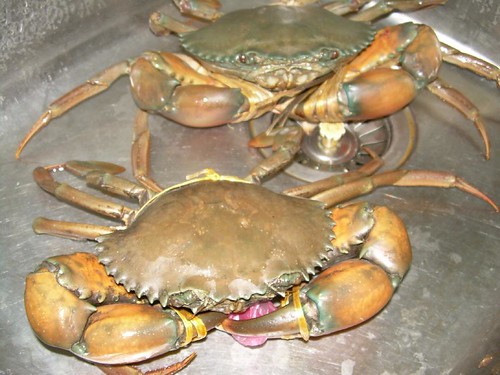
Crabs! Finally they appear on this site. There are many recipes for crabs but this Stir Fried Crabs recipe focuses on simplicity and natural goodness. The usage of garlic, ginger and spring onions help to mask away the slight “fishy” smell of the crabs (I use mangrove / mud crabs here) whilst maintaining the natural sweet taste of the flesh. Unlike other crab recipes like Marmite Crabs, Tomato Crabs, Kam Heong Crabs, Chilli Crabs, Black Pepper Crabs or Cheese Crabs which overpowers the natural sweet taste of the flesh, this recipe ensures that you get to enjoy crabs at its best. By the way, you only kill the crab just before cooking.
How does one kill crabs? Well, in Malaysia, these crabs are sold live and bound with strings or reeds. So, they are pretty safe to handle. You have to place the crab upside down and use either a knife or chopstick to kill it. Prior to this however, is to place the crab in a freezer for 15 minutes or so. This will sort of put the crab into hibernation mode and at the same time (from what I heard), will prevent the claw or other parts of the legs from dropping off immediately upon being killed. Anyway, after you have placed the crab upside down, poke a knife or chopstick through the centre portion of the crab (where there is a triangle looking portion on the underside of the crab). Alternatively, poke a chopstick through the soft part between the legs. See the photo below. Read the rest of this entry »


Hairy Gourd Soup
Soup October 10th, 2007
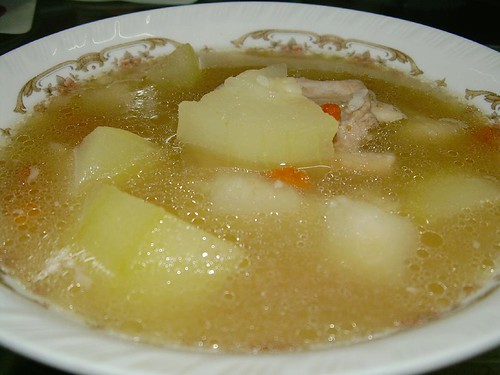
Hairy Gourd is also known as haired gourd, fuzzy gourd, fuzzy squash, Mao Gua, Mao Qua, Mokwa, Mo Kwa or Hairy Cucumber. It is essentially a cucumber looking gourd which has dark green and short hair. Well, don’t worry about the hairy bit because you will need to skin the gourd and only use the flesh for this soup. And just like most of the other soups you find on this site, you can either use the slow-cooker / crockpot, charcoal stove, gas stove or electric burner stove to cook it.
If you use the slow-cooker or charcoal stove, you will need to adjust the amount of water used. My usual rule of thumb is that if I want to serve one large bowl of soup, I will put in 1 1/2 bowls of water to cook it in a slow-cooker or charcoal stove and allow it to cook and reduce to one bowl. If I am using the gas or electric stove, I would put in 2 to 2 1/2 bowls of water instead. This is because water evaporates much faster in the gas and electric stove cooking. However, the funny thing is, if I want to serve 2 large bowls of soup, I would use not more than 3 bowls of water instead. It’s kind of hard to explain but it is just a habit I learn through cooking soup all these years. You just need to experiment and learn. One thing about cooking soup though, is not to add in additional water midway as it will somehow deteriorate the tastiness of the soup.
This is the recipe for Hairy Gourd Soup Read the rest of this entry »
Sambal Belacan Baby Corn
Vegetable October 8th, 2007
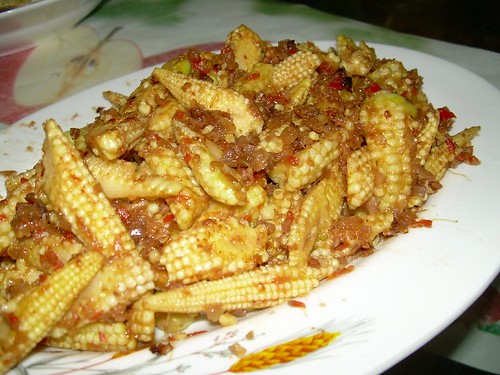
I am quite fond of baby corn as I find them tender, sweet and very appetising. The sweet nature of baby corns make it a wonderful accompaniment to mixed vegetables dishes. This dish, however, highlights the sweet baby corn in itself by pairing it with the irresistible sambal belacan - spicy and pungent prawn paste. It is quite simple to cook and ingredients are fairly minimal. Don’t let the photo presentation deceive you, this is a delicious dish on its own! 
This is the recipe for Sambal Belacan Baby Corn Read the rest of this entry »
Stir Fried Soya Bean Sprouts with Ikan Bilis
Vegetable October 4th, 2007
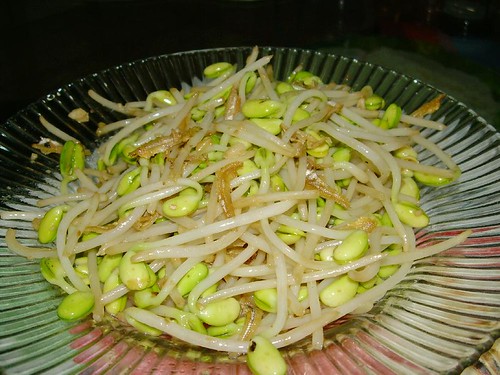
Soya Bean Sprouts are different from Mung Bean Sprouts. The former has a big bean head whilst the latter is smallish, which is understandable because soya beans are much bigger in size compared to mung beans. In the market, mung bean sprouts (most of the time just simply called bean sprouts) are easily available but not soya bean sprouts. You will also realise that mung bean sprouts have yellow coloured head (bean) after the removal of the dark green coloured skin covering the bean. As for the soya bean sprouts, you can see them above.
Cooking time wise, soya bean sprouts take a longer time to cook due to the bigger sized bean head. In terms of taste and texture, I think soya bean sprouts are slightly heavier in taste (sweeter) and no doubt, crunchier. When you are chewing on mung bean sprouts, you practically can only feel the texture of the body rather than the bean. I think soya bean sprouts are also more nutritious as what soya beans are famed for. If you can get your hands on the ingredients, try out this simple stir fry recipe.
This is the recipe for Stir Fried Soya Bean Sprouts with Ikan Bilis Read the rest of this entry »