web statistics Hochiak! Delicious Asian Food » 2007 » March

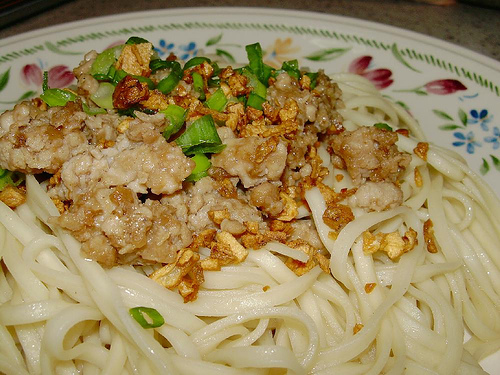
Kolok Mee

Noodles, Pork, Lunch, Chinese March 28th, 2007

kolo mee

Kolok Mee refers to a dry version of noodles originating from Sarawak (I stand corrected). It is sometimes known as Sarawak Kolo Mee or simply Kolok Mee. It takes a few platefuls of this noodles before it grows on you. Perhaps it has to be due to the fact that it is rather plain looking compared to other more colourful noodle dishes. However, once you grow to like it, it can be addictive.


What I have cooked here is my home-made version of the Kolok Mee. Not the making of the noodles but rather, the mixture of sauces which came up with the Kolok Mee taste. It can be a tad saltish to some, so you might want to go easy on the amount of seasoning used here. As for the noodles, I am using dried instant noodles bought from Sitiawan, made by the Foo Chow community. The texture (which is a bit like pasta, but stiffer) is quite suitable for this seasoning…almost like Kampua Noodles. Wantan noodles are also suitable, especially the curly stringy type. Yellow noodles are not suitable. As I don’t have char siew available, I have decided to just have minced pork only for the topping. Try this recipe if you can and adjust the measurements according to your preference.


This is my recipe for Kolok Mee (serves 3 portions)


Ingredients


  • 3 pieces of instant noodles
  • 100 grammes of minced pork
  • 1/2 bulb of garlic (finely chopped)
  • spring onions for garnishing (chopped finely)
  • 6 tablespoons of palm oil


Seasoning (for 3 servings)


  • 3 teaspoons of fish sauce
  • 1/3 teaspoon of salt
  • 1 teaspoon of light soya sauce
  • 1/3 teaspoon of monosodium glutamate
  • a couple of dashes of white pepper powder


Marinade (for minced pork)


  • 2 teaspoons of fish sauce
  • 1 teaspoon of light soya sauce
  • a couple of dashes of white pepper powder
  • 1 teaspoon of corn flour / potato flour


Method


Marinade minced pork for at least 1 hour.


Bring a pot of water to boil. Add instant noodles and cook till almost done. Remove noodles from pot using a net or colander and run it through cold or tap water. Return noodles to boiling water to heat it up again and thereafter, drain the noodles after 30 seconds. Set aside.


Heat oil in wok using medium high heat. Fry garlic till golden brown. Remove fried garlic and set aside.


Scoop up oil into a bowl leaving about 2 tablespoons of oil remaining in the wok. Increase heat to high and stir fry minced pork till completely cooked (about 2 minutes). Sprinkle some water whilst stir frying to prevent burning. The minced pork should be just moist after cooking and not soaking in gravy. Remove cooked minced pork and set aside.


In a large bowl, add all the seasoning and stir well. Add cooked instant noodles and stir till evenly coated by the seasoning. Separate the noodles onto three serving plates. Add some cooked minced pork and garnish with fried garlic and spring onions.


Technorati Tags: , , , , , , ,

Popularity: 100% [?]

If you enjoyed this post, make sure you subscribe to my RSS feed!

10 Things I want (for my kitchen)

Miscellaneous March 27th, 2007

The fabulous Paris Beaverbanks tagged me on this one a week ago and I haven’t really sat down to think of it. Perhaps, it is because I am actually quite contented (most of the time). There are, of course, things which I want (not needs, but wants) for my kitchen and these are the stuffs I am talking about:-


  1. A bigger kitchen (so that I have more space to move around and dance while waiting for the food to cook);
  2. An oven (preferably British) so that I can bake and roast food to my delight and add them to this site;
  3. A bigger refridgerator which consumes lesser amount of energy compared to the current one (which is quite an impossible request) so that I can stuff more stuffs inside;
  4. A full range of WMF stainless steel crockery (plus a bottle of stainless steel washer as well to keep’em shining);
  5. A full range of Zwiling knives so that I don’t have to cut food like using a jigsaw;
  6. A more powerful cooker hood which is suitable for Asian cooking (Asian cooking is notorious for its smokiness caused by stir fries)
  7. A cooker which blasts out fire like the tai chows (big fries) in town. Essentially, the bigger the fire, the more “wok breath” the dish will have which usually translates to nicer tasting food.
  8. A solid surface kitchen cabinet where I don’t have to use any chopping block…Bofi or Electrolux would be nice ;)
  9. Ingredients available as and whenever I need them for cooking (this again, is wishful thinking);
  10. Nice set of dishes so that I can place my food and make it look good artificially. Many a time, a good looking plate makes the food look better!

There there. My list of 10s. But of course, they are not necessities. I admit that one of my favourite spots in shopping centres are the household sections especially kitchen and dining stuffs. I like to go through all the kitchen utensils and what-nots but almost always, never buy anything. Call me a cungent. LOL!

And now, I shall tag the following people to see if they are interested to share their 10 things they want for their kitchen:-

Keropok Man

Technicolor Kitchen

Teczcape

Chef K.C.

and Food Fusion.


Popularity: 51% [?]

If you enjoyed this post, make sure you subscribe to my RSS feed!
Belacan Asparagus

Vegetable March 26th, 2007

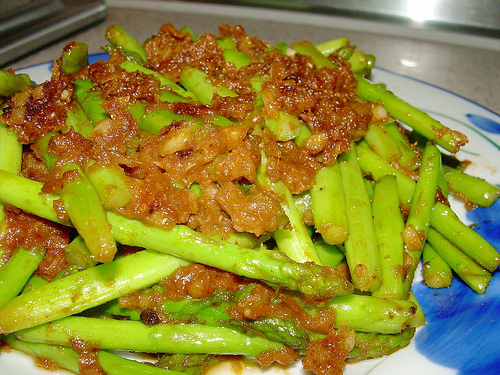
belacan asgaragus

When I put up my recipe for Stir-Fried Asparagus with Prawns, some of my favourite readers commented about their preference for Belacan Asparagus instead. Most, if not all, of these readers come from Malaysia / Singapore and belacan (prawn paste) is a hometown favourite. It is rather pungent (or can be offensive) in smell and you either like it or your don’t. However, I don’t really like the Belacan Asparagus sold in restaurants because I find that most of the time, they use far too much oil and thus render the dish rather unhealthy looking. Cooking for myself, however, is different as I could control the use of oil myself.


Recently, I saw an episode of Jamie Oliver’s and he taught a simple way of plucking the asparagus so that only the tender parts are used and the rests discarded for being too fibrous. All you need to do is to hold each end of the asparagus with your thumb and fingers and bend the middle part upwards. The stress of the bending will result in the asparagus breaking at a point which separates the tender part from the more fibrous part. Very easy but can waste quite a bit. So, having separated the tender parts, I go through the others and see if I could still salvage any other parts which are not so fibrous :)


This is my recipe for Belacan Asparagus


Ingredients

  • 200 grammes of asparagus (choose tender parts as per technique above)
  • 10 grammes or approximately 2 teaspoons of belacan
  • 30 grammes of dried prawns (pre-soaked for 15 minutes)
  • 5 cloves garlic
  • 5 cloves shallots
  • 3 to 5 pieces red chilli (remove seeds)
  • 1/2 cup warm water
  • 4 tablespoons palm oil


Method

Pound or blend belacan, pre-soaked dried prawns, garlic, shallots and chilli till it forms a paste.


Heat 2 tablespoons oil in wok on medium heat and saute belacan mix till aromatic / light brown. Add some oil if it starts to burn before becoming brown. Note that the belacan mix absorbs oil like tissue paper and therefore, you should try not to use too much oil or your asparagus will be found swimming in oil later.


Increase heat to high and add asparagus. Stir well and sprinkle warm water occasionally (you don’t have to use all the water above) to keep it moist and to let the dish cook in a little steam (but not soaking in water). Cook for about 2 minutes. No seasoning is required as the belacan mix is quite salty. You might want to sprinkle some sugar if you find it too salty.


Dish out and serve with steaming white rice.


Technorati Tags: , , , , ,

Popularity: 53% [?]

If you enjoyed this post, make sure you subscribe to my RSS feed!

Wo Tieh (Shallow Fried Dumplings)

Appetiser, Snacks, Pork, Chinese March 23rd, 2007

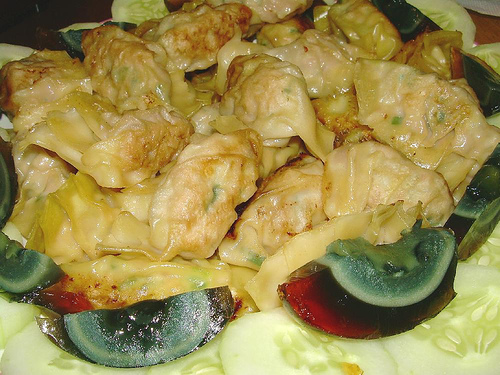
wo tieh

Wo Tieh is also known as Shallow Fried Dumplings. Some call them Pot Stickers because they are fried on shallow pans. These are not the same as wantons because they use thicker skin and is a flatter, more oblate, double-saucer like shape (similar in shape to ravioli), and is usually eaten with a ginger-soy-vinegar dipping sauce (and/or hot chilli sauce); while a wonton has a thinner skin, is sphere-shaped, and is usually served in broth. In the picture above, the wo tiehs are arranged in the middle (simply arranged with no artistic intention) with sliced century eggs and cucumbers. They go well together.


My sister cooked this dish for Chinese New Year Eve’s Dinner and it was a great appetiser as well as accompaniment to the steamboat fare we had.


This is my sister’s recipe for Wo Tieh (Shallow Fried Dumplings)


Ingredients


  • 200 grammes round cabbage (chopped finely)
  • 400 grammes semi-lean pork (mince it)
  • 50 grammes of chinese chives (chopped finely)
  • 200 grammes of prawns (chopped)
  • 3 cm ginger (chopped finely)
  • 3 cloves garlic (chopped finely)
  • 50 pieces of dumpling skin (choose the thicker ones, approximately 6 to 8 cm diameter and round shaped)
  • 400 ml warm water or chicken stock
  • Corn starch (mix 5 tablespoons water to 2 tablespoons corn flour to seal dumpling skin)
  • Oil for frying (palm oil)


Seasoning


  • 2 tablespoons chinese cooking wine
  • 3 tablespoons light soya sauce
  • 2 tablespoons sesame oil
  • 1 teaspoon white pepper powder
  • 1 teaspoon salt


Dip


  • Thinly julienned ginger
  • Black vinegar
  • a sprinkle of sugar


Method


In a large bowl, mix cabbage, pork, chives, prawns, ginger, garlic and seasoning. Stir and mix well forming one lump. Cover the mixture with cling film and set it aside for at least 1 hour.


To prepare dumplings, place one piece of dumpling skin on plate or table or hold spread out on one hand. Take one tablespoon of mixture and place it in center of skin. Using your finger, spread corn starch on edge of skin. Fold wrapper in half over the mixture and pinch centre of one edge. At the other end, make pleats to gather the mixture in the middle of the dumpling skin. Ensure that pleats at edges are tightly sealed and set the dumpling on a plate with sealed side up. Cover with moistened towel and work on the other dumpling skins till all mixture used up.


Heat a non-stick pan on high and lightly brush with oil. Fry the dumplings with the sealed side up by arranging as many dumplings together without touching each other. Fry till the bottoms start to brown and add a little water / chicken stock up to about 1 cm high. Cover with lid and allow water or stock to dry out. Continue to add same amount of water / stock and repeat process to cook till dumplings are firm (about 10 minutes). Finally, remove lid and brown the dumplings a little bit more (by now, you can brown the sides because the dumplings are firm enough and will not open up) for 1 minute.


Dish out and serve hot with dip.


Technorati Tags: , , , , , , ,

Popularity: 68% [?]

If you enjoyed this post, make sure you subscribe to my RSS feed!
Close
E-mail It


World Top Blogs - Blog TopSites PPS Powered by WordPress - WordPress Blogs Directory Top Food & Drink blogs SARA Blogdumps PabloPabla FrenzRSS Food & Drink Blogs - Blog Top Sites Blog Catalog HiTech News Harro.Com Blog Explosion Jom Makan! Outpost Blog Flux Directory Foodieblogs.Net